Parade
bahia
Parade
A women\'s drum troupe, with fanciful drumsand stickson parade through the streets of Pelourinho.
Fazenda da Lagoa Cabana
bahia
Fazenda da Lagoa Cabana
A Fazenda da Lagoa beach cabana, with linens designed by owner Mucki Skowronski.
Church of Nosso Senhor do Bonfirm
bahia
Church of Nosso Senhor do Bonfirm
Wax body partsofferings made on behalf of the infirmat the Church of Nosso Senhor do Bonfirm.
Church of the Third Order of St. Francis
bahia
church of the third order of saint francis
The intricate sandstone facade of Salvador\'s Church of the Third Order of St. Francis.
Convento do Carmo
bahia
Convento do Carmo
The view from the Convento do Carmo, a Salvador hotel, onto All Saints Bay.
Fazenda da Lagoa
bahia
Fazenda da Lagoa
The reception cottage at Fazenda da Lagoa, a resort south of Ilheus on the Cacao Coast.
Moqueca
bahia
Moqueca
Jardim das Delicias\'s
moqueca, a seafood stew.
Fazenda\'s Library
bahia
fazendas library
Fazenda\'s library, stocked with paperbacks for beach reading.
Bahia
bahia
Bahia
Map of Bahia.
Pelourinho
bahia
Pelourinho
A pastel-splashed backdrop in Salvador\'s UNESCO-preserved Pelourinho district.
Pelourinho Street
bahia
Pelourinho Street
Early morning on a cobblestoned street in Pelourinho.
Pool at Fazenda da Lagoa
bahia
Fazenda Pool
A candy-colored awning over the sundeck at Fazenda da Lagoa\'s pool.
Harbor of Ilheus
bahia
Harbor of Ilheus
Fishing boats anchored in the harbor of Ilheus, a 16th-century port.
Jardim das Delicias
bahia
Jardim das Delicias
A local street vendor in the doorway of Jardim das Delicias, in Salvador.
Bahia Beach
bahia
Bahia Beach
Swaronski and her Rhodesian ridgebacks, Cacao and Joaquim, roaming the beach at low tide.
Colorful Surfboard
bahia
colorful surfboard
A surfboard decorated by Skowronski, on display at the resort.
The statue of Jesus that watches over Salvador, Brazil, isn't quite as impressive as the one overlooking Rio de Janeiro. Compared with the colossus atop Corcovado, this one, on a bald outcropping on the Atlantic waterfront, is practically human in its proportions and easy to miss. But one feature stands out.
"Notice the hands," our guide, Mauro Marchesini, says with a crooked grin as we round a corner on Avenida Oceânica. There before us is the seven-foot-tall Christ in white marble, surrounded by tourists aiming cell-phone cameras. "One hand points south," Mauro says. "The other, to the ground. The message is: if you want to work, go south to Rio or São Paulo. But if you want to experience life, if you want to dance and celebrate and forget the rest of the world, stay right here in Bahia."
As if we needed confirmation from on high. For days my wife, Ruth, and I have been in Bahia, one of Brazil's largest states (the size of France), splitting time between the laid-back splendor of far-off beaches and Salvador, the pulsating and frequently unholy capital city of 2.5 million. The extremes we've encountered -- tropical isolation versus urban spectacle, chic retreats versus crumbling colonial treasures, posh high-rises versus unthinkable poverty -- speak to the complexities here. It is little wonder that writers like the late Jorge Amado, author of Dona Flor and Her Two Husbands, and musicians from Gilberto Gil to Caetano Veloso have found endless inspiration in Bahia's confounding dualities. Even God has to divide his attention.
As we say goodbye to Jesus, Mauro taps twice on the dashboard of our black sedan; our driver, Marcos, whisks us through Salvador's Lower City, passing hordes of locals as we go. Almost everyone is black and dressed in white.
"Is today a holiday?" Ruth asks.
"Every day is a holiday in Candomblé," Mauro says.
Although Brazil is the world's largest Roman Catholic nation, Candomblé is the primary faith in Bahia. The religion, which fuses Catholic rites with elaborate animistic ceremonies and offerings, is a living legacy of the millions of slaves the Portuguese brought here from West Africa over the course of three centuries, beginning in 1548. For generations Candomblé was practiced in shadowy secrecy, but it is now a mainstay of just about every church in Bahia -- and there are said to be 365 in central Salvador alone, one for every day of the year.
Today is Friday, when white is worn to honor Oxalá, the African deity of creation. Of course, the most lavish tributes are saved for Salvador's Carnaval celebration, arguably the world's largest; sequined drummers and masked and spangled dancers party through the night for a week, usually in late February, in homage to all manner of divine beings.
"Prepare yourself for five centuries under one roof," Mauro says as we reach Bonfim Square and the Rococo 18th-century Church of Nosso Senhor do Bonfim. It's hard to know when he's exaggerating. Though he was born in Salvador, Mauro's parents are Italian, and he has the wry wit of an outsider. "It is a holy place," he says. "Just hang on to your wallets and cameras."
He is right on all counts. Ceramic Portuguese tiles ornament the walls inside and out. Pilgrims of all ages file into the stifling Sala dos Milagres, the Miracle Room, where casts of body parts, in wax, plastic and even gold, dangle from the ceiling as thanksgiving offerings for cures. There are children everywhere, with vacant eyes and gnarled limbs, some begging for coins. Others are animatedly hawking Candomblé prayer beads or fitas, colorful ribbons tied around the wrist for good luck.
The luck, it turns out, is ours: we emerge to discover young musicians in Olodum Drum Troupe T-shirts performing in the church square. Paul Simon famously incorporated Olodum's mystical drumbeats on his 1990 album, TheRhythm of the Saints. Now the group, like many in the city, uses its clout to help young people such as its members find a way out of poverty through apprenticeships, education programs and simply making music in the streets. It's all enough to leave us feeling charged up and hungry for more.
"Will it be moqueca again?" Mauro asks. This is his way of teasing me. Since our first night in Bahia, I have been singularly obsessed with the spicy seafood stew (pronounced moh-KAY-kah), by far the tastiest emblem of Bahia's melting-pot mojo. As orange as a pumpkin, the dish teems with fragrant garlic, onions, tomatoes, coconut milk, whatever's fresh from the sea and red dendê oil, the local artery clogger. After the nearly twenty-four-hour trip to Bahia from Los Angeles (with layovers in Lima and São Paulo), the moqueca, served alongside piquant malagueta peppers and golden manioc flour, was as potent a jet-lag remedy as I can recall. So what if it's a cauldron of saturated fat?
Everywhere you go in Bahia, chefs emerge from kitchens, insisting that their moqueca is the finest in Brazil. With Mauro's help, I am determined to settle that score myself. He ushers us into Jardim das Delícias, his favorite moquecaria in the Pelourinho, the UNESCO-preserved neighborhood of colorful facades and slanted cobblestoned streets that is among the Americas' most stunning repositories of 16th- and 17th-century colonial architecture. In the bougainvillea-shaded courtyard, I speed-read the entrées, ignoring Ruth's plea to try something healthful for a change, and settle on a moqueca with shrimp, extra spicy.
"You know this quest just might kill you," Mauro says. He's probably right. But there's comfort in knowing I would die happy.
MENTION TO A savvy traveler that you're going to São Paulo and the expectation is that you're going for business. Rio, of course, conjures up images of hedonistic parties on beaches lined with hotels. But say "Bahia" to anyone who knows it and there's inevitably a pause, followed by a smile, followed by an envious "Ahhh, Bahia." Even if they don't realize it, what those people are sighing about is the Cacao Coast.
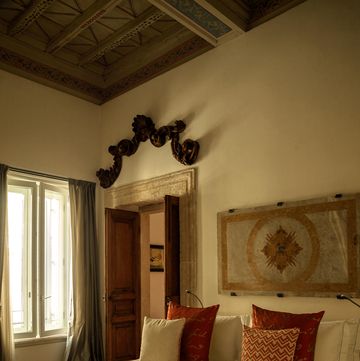
Put it this way: Salvador is the perfect place to spend several days at the start and end of a visit. It's called the Capital of Happiness for good reason. The sweeping vistas from the Upper City onto All Saints Bay are stunning. Shabby old colonial mansions are getting face-lifts; one is now the gleaming new Museu da Gastronomia Bahiana, a government-run cooking academy where women in turbans and bell-shaped dresses serve the classics of Bahian cuisine (such as xinxim de galinha, a traditional chicken-and-shrimp stew, and quindim, a yellow-custard dessert). And we stayed in the most dazzling Carmelite monastery on earth: the Convento do Carmo is a fabulously reconstructed 1586 friary in the heart of the Pelourinho, where our two-floor loft apartment had vaulted wooden ceilings and came with several plasma-screen TVs, L'Occitane bath products and a pillow menu that would answer any monk's prayers.
But there is a yang to Salvador's yin, and it lies along Bahia's ivory-white coast, about 180 miles to the south. When we touch down in Ilhéus after a short flight from the capital, the pace is noticeably slower. On the chauffeured forty-minute Land Rover ride to Fazenda da Lagoa, our hardest decision is whether we want to hear samba or bossa nova on the CD player.
Fazenda da Lagoa has been open only a few years, but we'd heard it was already drawing sophisticated customers like the designer Valentino and Lizzy Jagger. Then again, as we bounce along the potholed access road with darkness and the rain forest closing in around us, I suddenly wonder if we are in the right place. In fact, where on earth are we? Our driver doesn't speak a word of English, and we've come to the edge of a wide, inky black river. That's when we spot the boat -- the SS Mucki.
"Mucki" is Mucki Skowronski, a renowned artist and designer from Rio, who owns Fazenda da Lagoa with her husband, Arthur Bahia (yes, his real name). She welcomes us aboard her canopied ferry, which has bright-red cushions and pillows handsewn with colorful silhouettes of Brazil. As we cruise to the chic eco-resort, her sense of style wins out over our panic.
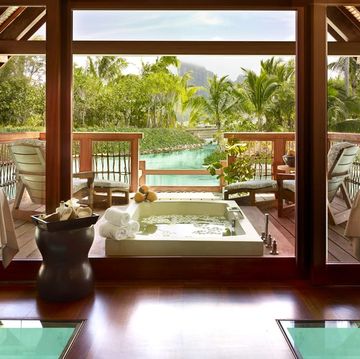
Mucki figured that the best way to preserve her 1,500 untouched acres along the coast was to build minimally (there are only fourteen cabins) but with maximum taste. That translates into guest pavilions with walls of sliding glass that open to the sea-scented air and groves of coconut palms. Inside are gauze-netted platform beds and a veritable Pop Art gallery of Mucki's splashy floral oil paintings, rainbow-striped wall hangings and hand-beaded chandeliers. (She does most of her work in a Rio atelier where she mentors teenagers plucked from the city's poorest favelas.) Behind our bed is a tapestry with delicately beaded stars as sparkly and awe-inspiring as the ones in the Southern Cross, overhead.
It's not until the next morning, however, that we behold the genuine star of this resort. We hadn't even seen the ocean when we arrived; now, as an arc of white sand stretches for miles in both directions without a footprint in sight, I understand where the languid groove in all those songs by João Gilberto, the father of bossa nova, comes from. Forget Ipanema: this is the beach of your dreams.
The best thing to do at Fazenda -- in fact, the best thing you may ever do -- is what we spend each morning doing: pedaling cruiser bikes along the hard-packed sand for what seems like forever, stopping here and there for a dip in seas so clean, so warm, so private, it feels illicit. At the resort itself, only a few of the staff members speak English, but that doesn't mean the service isn't world-class. Raise a flag on your cabin and a waiter in white will appear with a breakfast of fresh fruit, local eggs and Portuguese cheese bread. There is moqueca on the lunch and dinner menus, thankfully, and the servers remember exactly which chile peppers I like -- the tiny yellow malaguetas -- and have them sliced and ready for me each night.
The evening before we leave, we meet a couple from São Paulo in the main pavilion over toasted cashews and caipirinhas, the favorite local libation, made of cachaça, a sugarcane liquor, and tropical fruit juices. She is model beautiful; he has the glow of a successful businessman who has finally let the office go. He admits he's a perfectionist when it comes to picking his getaways. "In Brazil, everybody has a secret beach they think is the best," he says. "But between us, this really is the one."
THE TRUTH IS, there are secrets all along Bahia's coast, which contains some 600 miles of white-sand beaches. You simply need to know whom to ask. Susy Roosli is an exuberant Swiss expat with blonde hair and a string-bean figure whose business attire is a teeny bikini under a T-shirt and shorts. She came to Bahia twenty years ago and never left; she now runs Órbita Excursions and Tourism, a company we've hired to give us the lay of the land.
Susy and her hunk-of-a-Brazilian husband, Paolo Veloso, drive us through the heart of Bahia's cocoa and sugar plantations, which still provide their sweet goods to much of the world. Our first stop is back in Ilhéus, a vibrant colonial town founded in 1534. The writer Jorge Amado grew up here, and the city as he saw it lent a backdrop to his best-known novel, Gabriela, Clove and Cinnamon. In the Ilhéus of his books, cocoa barons kill one another for power and land; the city is swarming with thieves and prostitutes. Today Ilhéus is a sleepy beach town. Amado's mansion is a canary-yellow masterpiece in the middle of the city, with festive salons made of jacaranda wood and Carrara marble. But it's hard to imagine Amado himself getting a better reception in town than Susy and Paolo, who are honked at and waved to by nearly every driver and shopkeeper we pass.
Our plan is to lunch in Itacaré, the surf town forty miles to the north that's recently become a haven for talented artists (and escape artists) looking for Nirvana on earth. But Susy and Paolo are dead set on an adventure, and as we drive along the region's remote main road -- the BA-001 parkway, which wasn't paved until 1998 -- we end up at Txai resort instead.
Txai (pronounced chai), on a hillside ten miles south of Itacaré, is undoubtedly the most gorgeous place in South America to stop for lunch. Set amid coconut groves, the resort was the first truly glamorous hotel to open in Bahia, in 1999; aside from its glass-walled library and sumptuous spa, its charms are decidedly rustic. The sun-faded bungalows, in a hodgepodge of architectural styles, are simply appointed with furnishings of local hardwood. But its homey quality feels like a rain-forest antidote to the antiseptic sameness of so many ultraluxe resorts.
With the afternoon waning, we have time only for a quick açaí cocktail in Itacaré, which Ruth dubs "the cutest town ever." Susy and Paolo want to make sure we catch the last car ferry to the Maraú Peninsula, an all-sand elbow into the Atlantic that until 2003 was home mainly to fishermen, coconut farmers and the occasional pioneering backpacker. As such, it behooves me to downplay the joys of Kiaroa, the lavish new resort where we would spend the next few days. If you don't like private plunge pools in Balinese-style bungalows, a swim-up bar and food that is flown in fresh daily to the hotel's airstrip, then don't bother visiting. But I will say that the Bar das Meninas, a beach cantina in the nearby village of Taipu de Fora, serves a world-class (and blazingly hot) bowl of you-know-what.
"BACK FOR MORE punishment?" Mauro asks.
Returning to Salvador feels like coming home. Mauro and Marcos meet us at the private airport after our half-hour charter flight from Kiaroa -- the fastest way to make the trip -- and we quickly get down to business. Ruth has shopping to do; I have one last stop on my tasting tour. The moqueca at Jardim das Delícias was good, albeit in a Brazilian-auntie sort of way. But my sources are telling me there's nothing in town that rivals the fish stew -- or the chic ambience -- at Trapiche Adelaide.
At the end of a pier in a gentrified gallery district that was once the most derelict part of Salvador, the restaurant offers a glimpse of what the city itself may look like in years to come. The decor is modern, with a wall of windows above All Saints Bay; the service is sophisticated; and the menu is rich with international flavors, from the risotto with quail and shimeji mushrooms to the miniature apple pies for dessert. But the place still can't shake the power of Bahia's history. The most popular items are the ones that rise out of the vortex of influences that have shaped this region's music and culture as well as its food: vatapá, a shrimp, coconut-milk and palm-oil paste; acarajé, a spicy bean fritter from Nigeria.
This time, even Ruth can't resist joining me in moqueca heaven. As we look out to floodlit waters, dipping into the most elegant fish stew yet -- this one has mussels, shrimp, soft-shell crab and lobster -- we feel a rush of gratitude for the glorious ending to our pilgrimage. It's just in time, though. My soul may be willing, but my heart can't take much more.
NATIVE INTELLIGENCE: BAHIA
BAHIA LIES on Brazil's Atlantic coast between the equator and the Tropic of Capricorn. Roughly 800 miles north of Rio de Janeiro and São Paulo, Salvador is Bahia's urban hub and capital, a colonial jewel on an ancient bluff above All Saints Bay. The city is divided into two parts, Cidade Alta (Upper City) and Cidade Baixa (Lower City); the top hotels are in the historic Pelourinho district, in the Upper City. Getting around town on your own can be tricky -- narrow one-way streets, arcane traffic rules -- so it's advisable to use taxis or hire a driver through your tour company. Though the beaches everywhere in Bahia are spectacular, those to the south of Salvador -- on the so-called Cacao Coast, a short flight away -- are home to the sought-after resorts. English is taught in most schools, but it's helpful to travel with an English-speaking guide (see below) or else keep a Portuguese phrase book handy.
When to Go
It's no exaggeration to say that the weather in Bahia is almost always great: warm and humid year-round, with temperatures averaging seventy-eight degrees. The best time to go depends on your appetite for festivities and crowds. December through March is the celebration season, especially during Carnaval, usually in late February. If it rains at all, it does so between April and July.
Getting There
American Airlines (aa.com) flies direct to Salvador from Miami (nearly eight hours) every night, with a connection from New York's JFK. Last year Korean Air (koreanair.com) launched the only nonstop service between Los Angeles and São Paulo, with overnight flights three times a week.
Travel Experts
Based in Salt Lake City, PanAmerican Travel Services (800-364-4359; panam-tours.com) is a high-end tour company that really knows Bahia; agents Doug Wren and Brett Steele have lived there and return often. In Brazil, Susy Roosli, at Órbita Excursions and Tourism (011-55-73-9983-6655; orbitaexpedicoes.com.br), has a sixth sense for divining the finest hotels and hidden beaches. Salvador tour guide Mauro Marchesini (011-55-71-9144-4400) speaks English well; he is knowledgeable and beyond accommodating.
Where to Stay
Oasis in the City
For elegance in bustling Salvador, nothing comes close to the Convento do Carmo. The magnificently renovated former friary, with courtyards, gardens, stately dining areas and a spa, dates from 1586 and is a sanctuary on a hill atop the Pelourinho. Doubles from $350. 1 Rua do Carmo, Salvador; 011-55-71-3327-8400; pestana.com.
Designer Chic on White Sand
Rio fashionista Mucki Skowronski's Fazenda da Lagoa is as stylish as it is remote. With fourteen brightly colored bungalows on an untouched Atlantic reserve forty minutes south of Ilhéus, this is Valentino's hangout of choice on these perfect shores. Romantics need look no further. Villas from $450, including breakfast and dinner. Una-Ilhéus; 011-55-73-3236-6046; fazendadalagoa.com.br.
A Taste of Paradise
It's impossible not to love the luxurious yet laid-back Txai resort, one hour north of Ilhéus. For soaking up the splendor of the Cacao Coast, there are few places that can match a mahogany tub in Shamash, the hilltop spa above the Atlantic. Book one of the forty rustic rooms, or rent a bungalow on stilts. Doubles from $450, bungalows from $650. Itacaré; 011-55-11-3513-4322; txai.com.br.
Bahia by Way of Bali
Amid sleepy fishing villages on the Maraú Peninsula, KiaroaEco-Luxury Resort, about three hours north of Ilhéus, offers upscale accommodations in twenty-eight suites and bungalows. The thatch-roofed oceanfront villas are the ones to book: most have a personal plunge pool. The inviting 8,600-square-foot main pool, tiled by hand, has a palm-enshrouded island in the middle and a swim-up bar. At the spa, don't miss the Armonía Ritual couples' four-hand massage. Doubles from $415, bungalows from $735, including breakfast and dinner. Maraú; 011-55-71-3272-1320; kiaroa.com.br.
Where to Eat
Named for Bahia's literary lion, Amado is Salvador's best new restaurant for contemporary Brazilian cuisine, like chicken in molho pardo (blood sauce) and black anchovies over asparagus risotto. It's worth having a caipirinha at the bar for the views of All Saints Bay alone. 660 Avenida Lafayete Coutinho, Comércio, Salvador; 011-55-71-3322-3520; amadobahia.com.br.
Colonial grandeur and fiery fish stews in a garden setting make Jardim das Delícias a must on any moqueca tour. 12 Rua João de Deus, Pelourinho, Salvador; 011-55-71-3321-1449.
Sleek and chic in a reborn wharf district, Trapiche Adelaide serves classic Bahian dishes as well as sophisticated international fare. 2 Avenida do Contorno, Lower City, Salvador; 011-55-71-3326-2211; www.trapicheadelaide.com.br.
On the Maraú Peninsula, a short stroll down the beach from Kiaroa resort, the Bar das Meninas is a supercasual lunch spot (moqueca, grilled local fish) where you can live out your barefoot-in-the-sand fantasies. Taipu de Fora, Maraú; 011-55-73-3258-9035.
Where to Shop
In Salvador, housed in an 18th-century colonial mansion in the Pelourinho, D. Kläy Gems & Arts brings Swiss quality to jewels like the imperial topaz, mined only in Brazil. Stones can be purchased individually or as jewelry made on-site. On the ground floor the company runs a school to train disadvantaged youths from the community as goldsmiths and gem cutters. 27 Largo da Cruz do Pascoal, St. Antônio Além do Carmo, Salvador.
The colorful boutique Baú Baú has a fine collection of alluring folk art and paintings. 37 Rua Gregória de Matos, Pelourinho, Salvador; baubau.com.br.
For first-rate art and antiques, try Oxum Casa de Arte. Among the porcelain and gilded mirrors are pieces by noted muralist and painter Carybé, whose work is in Salvador's Afro-Brazilian museum. 18 Rua Gregória de Matos, Pelourinho, Salvador.
Opened in 2006, the government-run Museu da Gastronomia Bahiana is a restaurant and culinary institute and the place to find Bahian cookbooks, foodstuffs and kitchen utensils.
LOG-IN TO POST A COMMENT
POST A COMMENT