Munich Old and New
munich
munich
Munich\'s Marienplatz dates back to the Middle Ages.
Munich Old and New
munich, olafur eliasson, sphere
sphere
Olafur Eliasson\'s stainless-steel
Sphere (2003) hangs in the Fünf Höfe shopping arcade.
Munich Old and New
munich, brenner grill
munich
The Brenner Grill, housed in the former royal stables.
Munich Old and New
munich, marstall
munich
M is for Marstall, a theater specializing in experimental productions.
Munich Old and New
munich, isar river
munich
Sunbathers relax on the gravel shores of Munich\'s Isar River.
Munich Old and New
munich, bayerischer hof, blue spa
munich
The terrace of the Bayerischer Hof hotel\'s blue spa.
Munich Old and New
munich
munich
The Siegestor, on Leopoldstrasse.
Munich Old and New
munich
munich
An exhibit at the Pinakothek der Moderne.
Munich Old and New
munich, charles hotel
munich
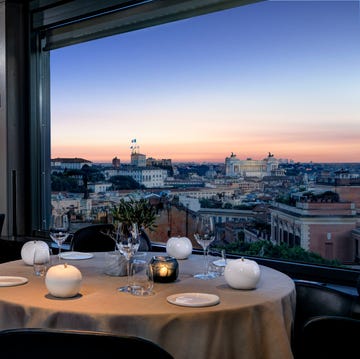
The restaurant at the Charles Hotel.
Munich Old and New
munich, allianz arena
munich arena
The Allianz Arena.
Munich Old and New
munich, jewish museum
munich jewish museum
The new Jewish Museum Munich.
Munich Old and New
munich, surfing, eisbach canal
eisbach canal
A surfer catches a wave on the Eisbach Canal.
Munich Old and New
munich, charles hotel
munich charles hotel
Paintings by Bavarian artist Franz von Lenbach hang throughout the Charles Hotel.
Munich Old and New
munich, beer garden
munich beer garden
The beer garden at the Chinesischer Turm, in the English Garden, packed on a sunny day.
I remember the exact day I fell in love with Munich.
It was a few months after my husband and I moved to the city, in late 2006, on a blue-sky afternoon in April that felt like the start of summer. We decided to take a leisurely stroll to an Andreas Gursky exhibit at the Haus der Kunst, the city's contemporary-art museum. From our bohemian residential neighborhood of Haidhausen, we headed toward Munich's center, passing the Müllersches Volksbad, an elegant Art Nouveau bathhouse, and crossed the Isar River. Sunlight sparkled on the surface of the water and warmed the skin of the sunbathers gathered along its pebbled banks.
We walked through the 19th-century Isartor city gate to Tal, one of the few urban-looking streets in Munich's historic heart. To the south stood the Viktualienmarkt -- and a scene right out of a Brueghel painting; to the west was the Marienplatz, a giddy mosaic of Baroque and neo-Gothic architecture that is home to the much-photographed Glockenspiel. The onion-domed 15th-century Frauenkirche towered above the plaza.
We turned north toward the Odeonsplatz -- an expansive cobblestoned square lined with Italian Baroque-style buildings -- and then meandered through the Hofgarten, whose trees were newly in bloom. Just before the entrance to the English Garden, we spotted a crowd looking at something from a small bridge over the garden's Eisbach Canal. Squeezing ourselves into the thronged onlookers, we followed their gaze downward. I blinked. Below us, a neoprene-clad surfer was riding a narrow perpetual wave on the fast-moving water. At least eight other surfers were lined up on both sides of the canal, waiting their turns.
Hanging ten in the historic heart of Munich? It turned out that the man-made Eisbach Wave had been tempting rebellious German surf bums to test their skills (illegally) since the seventies. My stereotyped image of Munich as a city trapped in a contrived Bavarian snow globe had been smashed to pieces. I realized then and there that my new home had its own unique edge -- often hidden in plain sight in the most traditional spots.
MUNICH MAY BE A HIGH-TECH metropolis of a million and a half people, but it can often feel more like an age-old village out of Grimm's fairy tales. The city, like the southern German state of which it is the capital, tends to be defined by all the famous Teutonic clichés: cuckoo clocks; enormous glasses of beer; plump, lederhosen-clad men eating sausages. For some, Germans included, it also dredges up disturbing memories of World War II, when it was a Nazi stronghold and subsequently flattened by Allied bombs. But for many others, Munich is the country's richest and chicest urban center, the stomping ground of high society.
To understand the glamorous associations of my adopted city, one need only rent Kir Royal, a cult German miniseries that premiered in 1986. The TV show followed Baby Schimmerlos, a gossip reporter for a Munich tabloid, and spotlighted the city much as Sex and the City showcased Manhattan. Baby's exploits with Munich's Schickeria (trendsetters) -- he is often shown dancing on tables with them at a panoply of hip, expensive Italian restaurants -- still color the contemporary German consciousness and epitomize that era of excess.
A key figure of the Roaring Eighties in Munich was Gerd Käfer, who ran a gourmet shop that became Germany's most successful and stylish caterer. It did all the best parties -- and still does. Of the fourteen tents erected in the grassy Theresienwiese Park for Oktoberfest, under which all the action and drinking take place, the tent sponsored by Käfer is considered one of the most prestigious, typically attracting all the local and international celebrities. These days, Käfer's son, Michael, runs the family business, which has grown to include a popular restaurant, Käfer-Schänke; he also owns the P1 club, Munich's most famous nightclub. A laid-back, shaggy-haired fiftysomething, Michael Käfer believes that Munich is Germany's premier city. "It's safe, and there are such beautiful surroundings -- the Alps and the lakes," he says. "Plus, you have a great deal of money and important companies like BMW and Siemens based here."
And although Germany has been hit by the recession along with the rest of the world (prices have come down, but you'll still pay $150 for dinner for two), Munich's citizens somehow retain an overwhelmingly positive outlook. "Müncheners will always love their town," the Vivienne Westwood-trained designer Lola Paltinger proclaims over coffee in her atelier, on Tal. "They appreciate tradition and take seriously the art of living. I walk through the Viktualienmarkt, and everyone is sitting outside and drinking a beer. I'm actually surprised at how many people are enjoying their life in the middle of a weekday." Local society women continue to spend thousands of euros for one of Paltinger's custom dirndls, made of contemporary fabrics like lace and gold lamé, which are on full display during Oktoberfest, when Munich is transformed into one big, rollicking fraternity party.
MUNICH'S MOVE INTO the 21st century has been a slow and methodical process -- this is Germany, after all -- fueled by the big booms of the eighties and nineties, the new money that followed and, most recently, the growth of the biotech sector, which has kept euros flowing even during the downturn. As with many Old World cities (Munich was founded in 1158), nostalgia remains strong. Rather than tear down buildings, city planners have restored them while carefully adding a limited number of contemporary structures: the luminous Allianz Arena, designed by Herzog & de Meuron for the 2006 World Cup, is frequently touted as the most beautiful stadium on earth. Almost eight decades after it was first envisioned, the Jewish Museum Munich, a dramatic stone cube conceived by the German architecture firm Wandel Hoefer Lorch, was finally unveiled in 2007. The Brandhorst Museum, home to 700 contemporary artworks by the likes of Twombly, Hirst and Richter, opened in May. And later this year, architect Norman Foster will begin erecting the Lenbachhaus Museum, which will be housed in a villa once owned by the "painter prince," Franz von Lenbach.
As in any evolving city, there is a downtown scene; here it's south of the Viktualienmarkt in the Glockenbach district. Like Chelsea in New York, Glockenbach has a large gay population that has helped turn it into an upscale, cutting-edge neighborhood sprinkled with independent stores, cool cafés and ateliers. This is where I found Singa-Pur, my favorite massage place, run by two sweet but strong half-Malaysian, half-German sisters, and Tekkelklub, a kooky little shop that never seemed to be open -- the sign read "Auf is', wenn auf is'!" which translates loosely as "We're open when we're open" -- but had adorable dachshund-print T-shirts in the window. For a more uptown scene, I went in the opposite direction, toward the elegant Odeonsplatz and Munich's Fifth Avenue, Maximilianstrasse. That legendary promenade, which stretches from the grand opera house to the Isar River, is an impressive mix of Gothic and Italian-inspired monuments, plus all the requisite designer boutiques: Gucci, Chanel and Dior, to name a few. In the summer months, I was shocked to notice the street suddenly populated by groups of women draped in burkas and laden with purchases. A friend explained that for the past few years, wealthy Saudi families have been arriving en masse to take advantage of the city's excellent medical facilities and, of course, to shop.
Whether browsing the stores or ambling along the river, you can see all sorts of people on the streets of Munich; there's a sleek and efficient, graffiti-free subway system, but the city is incredibly walkable, so nearly everyone gets around on foot. Even the place I love best -- the tranquil English Garden, one of the world's largest urban parks, with the narrow Eisbach Canal winding through it -- is within walking distance from almost anywhere in town. To me, the garden is a little bit like the city itself: three parts tamed beauty and one part caprice (the small nudist section near the canal is a case in point). Going there put me so at ease that when it came time to choose a birth clinic for my first pregnancy, I picked one within the garden.
My daughter is almost two, and we now live in Berlin. At the beginning of the year, my husband got a new job that moved us to this crazy capital, but I often find myself yearning for Munich's blue skies and Baroque streets. There are few other historic cities where you can stumble upon such completely unexpected scenes: a group of friends grabbing a pint in the Viktualienmarkt beer garden at 10:00 A.M., a gaggle of teenaged girls strolling along a cobblestoned street in peacock-bright dirndls or a surfer hanging ten on the Eisbach Canal.
MAKING THE MOST OF MUNICH
WHERE TO STAY
The city's most prestigious hotel is the 303-room Vier Jahreszeiten Kempinski, ideally located on Maximilianstrasse, the Fifth Avenue of Munich. Its mahogany-paneled lobby draws a sophisticated crowd of locals, who come to sip cocktails and listen to the famed pianist Simon Schott. Doubles from $333. 17 Maximilianstrasse; 011-49-89-21-250; kempinski-vierjahreszeiten.com.
Italian hotelier Sir Rocco Forte recently opened the Charles Hotel, the first luxury property to debut in Munich in years. Sir Rocco's sister, Olga Polizzi, designed the 132 rooms and twenty-eight suites with a warm palette, displayed in the cherrywood furniture, the soft organic fabrics and the freshly cut flowers. Although situated on the "wrong" side of town, the Charles is less than a ten-minute walk from the Marienplatz, and many of the rooms, especially those on the top floors, have impressive views of the city and the nearby Botanical Gardens. Doubles from $650. 28 Sophienstrasse; 011-49-89-544-5550; charleshotel.de.
Discreetly tucked between Maximilianstrasse and the Viktualienmarkt, the Cortiina is an intimate hotel that attracts independent businesspeople and Munich insiders. Interiors are modern and understated, showcasing acres of local materials like copper, oak and stone. Doubles from $299. 8 Ledererstrasse; 011-49-89-242-2490; cortiina.com.
WHERE TO EAT
Expect to pay around $150 for dinner for two at the following restaurants. In the countless beer gardens, about $15 will buy you a meal.
Munich has plenty of traditional, low-key beer halls, but the Spatenhaus an der Oper is the most upscale. Located in a historic building overlooking the opera house, it serves a wide selection of Bavarian dishes, such as duck with red cabbage and dumplings, and suckling pig in beer sauce. On a warm day, the outdoor terrace is an ideal spot from which to people-watch. 12 Residenzstrasse; 011-49-89-290-7060.
Despite its unfortunate reputation for being Hitler's favorite restaurant, Osteria Italiana has managed to become Munich society's upscale choice for pasta, which Müncheners adore even more than they love dumplings. 62 Schellingstrasse; 011-49-89-272-0307; osteria.de.
The restaurant of the moment is the Brenner Grill, a vast space in a hidden courtyard off Maximilianstrasse, which has large arched windows and thick columns and seats more than 300. A troop of chefs prepares steaks, Italian sausages and fish at cooking stations in the center of the restaurant, adding to the spectacle of an almost always full house. 15Maximilianstrasse; 011-49-89-452-2880; brennergrill.de.
Among the 140 food vendors at the bustling Viktualienmarkt, you'll find some excellent Munich-style street fare. Try the organic Weisswurst served with sweet mustard and a pretzel at Kleiner Ochs'nbrater and delicious homemade soups at Münchner Suppenküche.
For decades, Germans have been making the pilgrimage to the gourmet shop Käfer. Several years ago, Käfer-Schänke, the dining room upstairs, was redone as a cheery space with red and light-wood surfaces that evoke a modern chalet. The international menu includes all the greatest hits, from herb-crusted lamb with goat-cheese polenta to steak tartare with caviar. 73 Prinzregentenstrasse; 011-49-89-416-8247; feinkost-kaefer.de.
WHERE TO SHOP
Even the trendiest fashionista will find something to admire at Ed Meier, a traditional Bavarian clothing emporium and Germany's oldest existing shoemaker. Many of the classics -- from canvas travel bags to hunting jackets -- have been updated, but the quality of the handicraft remains the same. All deliveries are by horse-drawn carriage. 22 Residenzstrasse; 011-49-89-220-044; edmeier.de.
Both architecture buffs and shopaholics love the Fünf Höfe, a Herzog & de Meuron-designed arcade winding through five connected buildings in the city's historic center. It houses everything from Muji and D&G to a modern-art exhibition hall. Between Theatinerstrasse and Kardinal-Faulhaber Strasse; fuenfhoefe.de.
The Barneys of Munich is Theresa, a small department store with three floors of well-edited international labels such as Azzaro and Yves Saint Laurent. 3 Maffeistrasse; 011-49-89-224-845; mytheresa.com.
Cosmopolitan fashion pros like Heidi Klum flip for Flip, a large boutique packed with lesser-known designers' collections, including Maxime Cossoguy and Mara Hoffman. Owner Gabriele Bohlen has been friendly with Patricia Field, the costume designer for Sex and the City, for years; if Carrie Bradshaw had ever traveled to Munich, this is surely where she'd have shopped. 6 Feilitzschstrasse; 011-49-89-3808-8659; flipmunich.de.
Lola Paltinger's atelier, Lollipop & Alpenrock, is a private showcase for her custom-made modern dirndls -- sought after by Munich's most fashionable society women -- which start at about $3,000. By appointment only. 27 Tal; 011-49-89-201-1114; lolapaltinger.com.
WHAT TO DO
The austere Haus der Kunst building, commissioned by Hitler in 1933, is one of the city's most important contemporary-art museums. The excellent exhibitions range from the photography of Andreas Gursky to the provocative works of Gilbert & George. 1Prinzregentenstrasse; 011-49-89-211-270; hausderkunst.de.
Designed in 2002 by Stephan Braunfels, the Pinakothek der Moderne is actually four museums under one roof, each focusing on a different subject: sculpture, works on paper, design or architecture. On Sundays admission is about $1.30 -- just make sure to go early to avoid the crowds. 40 Barer Strasse; 011-49-89-2380-5360; pinakothek.de.
Since 1747 the Porzellan Manufaktur Nymphenburg has been crafting one-of-a-kind handmade porcelain pieces for Europe's royal families and serious collectors. Nowadays the company's output, which includes commissions by designers such as Ted Muehling and Hella Jongerius, is coveted by international tastemakers. Nymphenburg workshop tours are on Wednesdays; reservations required. 8 Nördliches Schlossrondell; 011-49-89-179-1970; nymphenburg.com.
WHERE TO PLAY
Schumann's(6-7 Odeonsplatz; 011-49-89-229-060; schumanns.de) is to Munich what Rick's bar was to Casablanca: a legendary meeting place with serious cocktails. Opened nearly thirty years ago by the handsome Charles Schumann (he models on the side), the bar is as stylish as ever. The new offshoot, Schumann's TagesBar (6 Maffeistrasse; 011-49-89-2421-7700), in the Fünf Höfe, is equally jammed with a well-heeled crowd.
When the sun is shining, Munich insiders book a day at the Bayerischer Hof hotel's Blue Spa. Not only does it have a rooftop pool and a wraparound sundeck, but from this privileged spot, guests have one of the most stunning views of the city. If you can't spare the day, come at sundown to sip a cocktail on the terrace. 2-6 Promenadeplatz; 011-49-89-212-0992; bayerischerhof.de.
Even in winter you'll find hard-core locals and tourists enjoying cold brews at the city's many beer gardens. Two of the most beloved are the ones in theViktualienmarkt and at the Chinesischer Turm, in the English Garden, both of which serve very good Bavarian food.
The P1 club, located under the Haus der Kunst, has had several incarnations since 1949. Owned by Michael Käfer for the past twenty-five years, it is Munich's most celebrated nightclub. 1 Prinzregentenstrasse; 011-49-89-211-1140; p1-club.de.
Intimate H'ugo's Pizza is a hot spot for the local in-crowd. People come here to see and be seen, eat a decent pizza and dance on the tables. For Friday or Saturday night, reserve a week in advance. 1-3Promenadeplatz; 011-49-89-221-270; hugos-pizza.de.